现代粒子物理学导论(第三版)(英文影印版) - 中外物理学精品书系 - 中国高校教材图书网
|
书名: |
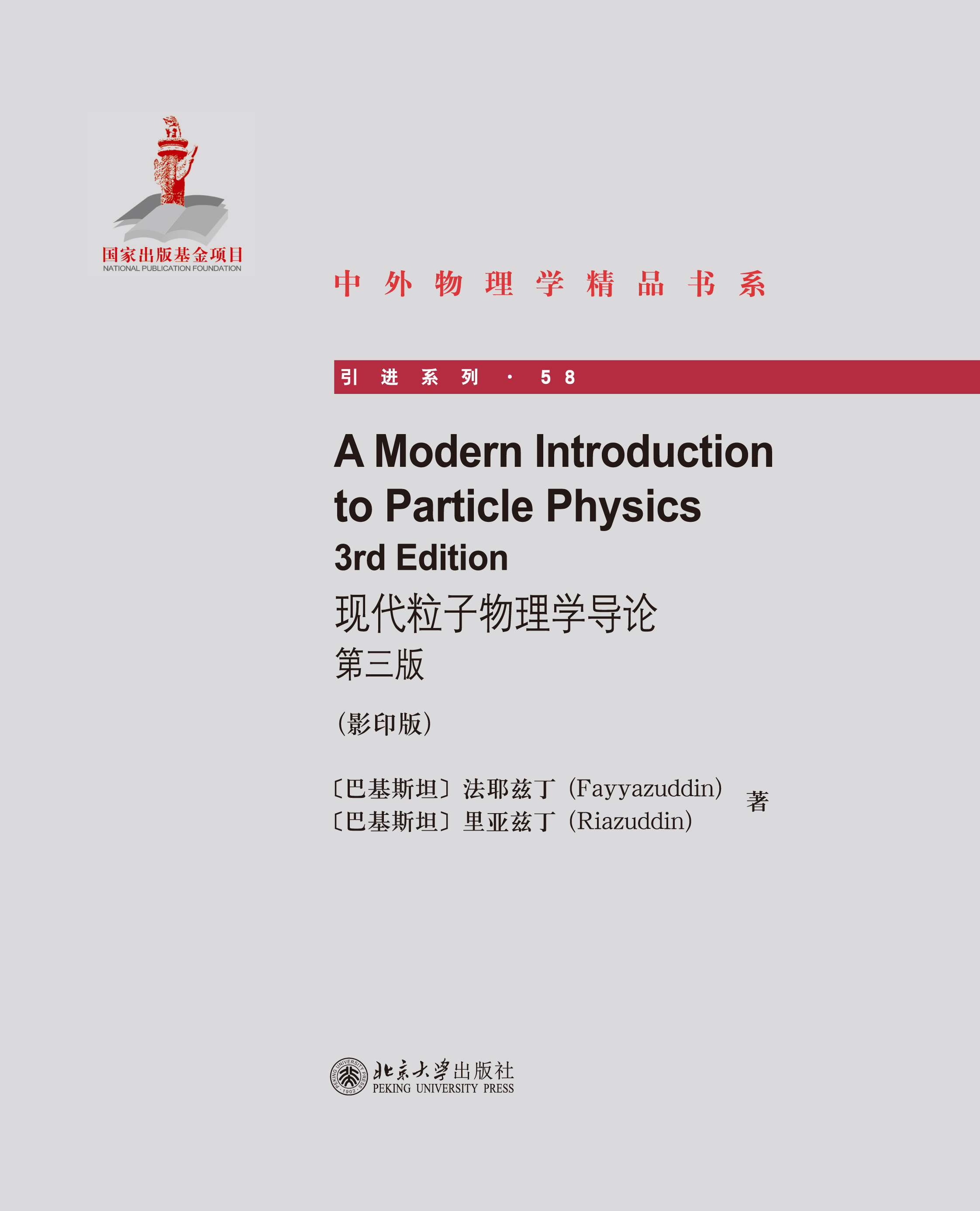
现代粒子物理学导论(第三版)(英文影印版)
中外物理学精品书系
|
| ISBN: | 978-7-301-25174-4 |
责任编辑: | |
| 作者: |
(巴基斯坦)法耶兹丁(Fayyazuddin)等
相关图书
|
装订: | |
| 印次: | 1-1 |
开本: | 16开 |
| 定价: |
¥116.00
折扣价:¥110.20
折扣:0.95
节省了5.8元
|
字数: |
683千字
|
| 出版社: |
北京大学出版社 |
页数: |
684页
|
| 出版日期: |
2014-12-24 |
每包册数: |
|
| 国家规划教材: |
|
省部级规划教材: |
|
| 入选重点出版项目: |
|
获奖信息: |
|
|
|
| 内容简介: |
|
本书涵盖了粒子物理各种方向,包括量子电动力学、夸克模型、标准模型等等。在理论和实验两方面都进行了系统讲解。此外,本书还着重讨论了天体物理、宇宙学和粒子物理学的交叉研究,即天体粒子物理学。 本书适合粒子物理、核物理、天体物理等领域的研究者和研究生阅读。
|
| 作者简介: |
|
巴基斯坦国家物理中心教授,巴基斯坦国家物理中心教授,巴基斯坦国家物理中心教授,巴基斯坦国家物理中心教授,巴基斯坦国家物理中心教授,巴基斯坦国家物理中心教授,巴基斯坦国家物理中心教授,
|
| 章节目录: |
|
Preface vii 1. Introduction 1 1.1 Fundamental Forces . . . . . . . . . . . . . . . . . . . . . 1 1.1.1 The Gravitational Force . . . . . . . . . . . . . . 2 1.1.2 The Weak Nuclear Force . . . . . . . . . . . . . . 2 1.1.3 The Electromagnetic Force . . . . . . . . . . . . . 3 1.1.4 The Strong Nuclear Force . . . . . . . . . . . . . . 4 1.2 Relative Strength of Four Fundamental Forces . . . . . . 4 1.3 Range of the Three Basic Forces . . . . . . . . . . . . . . 5 1.4 Classi_cation of Matter . . . . . . . . . . . . . . . . . . . 7 1.5 Strong Color Charges . . . . . . . . . . . . . . . . . . . . 9 1.6 Fundamental Role of \Charges" in the Uni_cation of Forces 10 1.7 Strong Quark-Quark Force . . . . . . . . . . . . . . . . . 16 1.8 Grand Uni_cation . . . . . . . . . . . . . . . . . . . . . . 18 1.9 Units and Notation . . . . . . . . . . . . . . . . . . . . . . 19 1.10 Problems . . . . . . . . . . . . . . . . . . . . . . . . . . . 21 1.11 References . . . . . . . . . . . . . . . . . . . . . . . . . . . 21 2. Scattering and Particle Interaction 23 2.1 Introduction . . . . . . . . . . . . . . . . . . . . . . . . . . 23 2.2 Kinematics of a Scattering Process . . . . . . . . . . . . . 26 2.3 Interaction Picture . . . . . . . . . . . . . . . . . . . . . . 31 2.4 Scattering Matrix (S-Matrix) . . . . . . . . . . . . . . . . 32 2.5 Phase Space . . . . . . . . . . . . . . . . . . . . . . . . . . 36 2.6 Examples . . . . . . . . . . . . . . . . . . . . . . . . . . . 39 2.6.1 Two-body Scattering . . . . . . . . . . . . . . . . 39 2.6.2 Three-body Decay . . . . . . . . . . . . . . . . . . 41 2.7 Electromagnetic Interaction . . . . . . . . . . . . . . . . . 50 2.8 Weak Interaction . . . . . . . . . . . . . . . . . . . . . . . 52 2.9 Hadronic Cross-section . . . . . . . . . . . . . . . . . . . . 55 2.10 Problems . . . . . . . . . . . . . . . . . . . . . . . . . . . 56 2.11 References . . . . . . . . . . . . . . . . . . . . . . . . . . . 58 3. Space-Time Symmetries 59 3.1 Introduction . . . . . . . . . . . . . . . . . . . . . . . . . . 59 3.1.1 Rotation and SO(3) Group . . . . . . . . . . . . . 60 3.1.2 Translation . . . . . . . . . . . . . . . . . . . . . . 62 3.1.3 Lorentz Group . . . . . . . . . . . . . . . . . . . . 63 3.2 Invariance Principle . . . . . . . . . . . . . . . . . . . . . 65 3.2.1 U Continuous . . . . . . . . . . . . . . . . . . . . 65 3.2.2 U is Discrete (e.g. Space Reection) . . . . . . . . 66 3.3 Parity . . . . . . . . . . . . . . . . . . . . . . . . . . . . . 66 3.4 Intrinsic Parity . . . . . . . . . . . . . . . . . . . . . . . . 68 3.4.1 Intrinsic Parity of Pion . . . . . . . . . . . . . . . 70 3.5 Parity Constraints on S-Matrix for Hadronic Reactions . . 71 3.5.1 Scattering of Spin 0 Particles on Spin 1 2 Particles 71 3.5.2 Decay of a Spin 0+ Particle into Three Spinless Particles Each Having Odd Parity . . . . . . . . . 72 3.6 Time Reversal . . . . . . . . . . . . . . . . . . . . . . . . 73 3.6.1 Unitarity . . . . . . . . . . . . . . . . . . . . . . . 74 3.6.2 Reciprocity Relation . . . . . . . . . . . . . . . . . 75 3.7 Applications . . . . . . . . . . . . . . . . . . . . . . . . . . 76 3.7.1 Detailed Balance Principle . . . . . . . . . . . . . 76 3.8 Unitarity Constraints . . . . . . . . . . . . . . . . . . . . 77 3.8.1 Two-Particle Partial Wave Unitarity . . . . . . . . 79 3.9 Problems . . . . . . . . . . . . . . . . . . . . . . . . . . . 85 3.10 References . . . . . . . . . . . . . . . . . . . . . . . . . . . 90 4. Internal Symmetries 91 4.1 Selection Rules and Globally Conserved Quantum Numbers 91 4.2 Isospin . . . . . . . . . . . . . . . . . . . . . . . . . . . . . 97 4.2.1 Electromagnetic Interaction and Isospin . . . . . . 100 4.2.2 Weak Interaction and Isospin . . . . . . . . . . . . 101 4.3 Resonance Production . . . . . . . . . . . . . . . . . . . . 101 4.3.1 _-resonance . . . . . . . . . . . . . . . . . . . . . 103 4.3.2 Spin of _ . . . . . . . . . . . . . . . . . . . . . . . 103 4.4 Charge Conjugation . . . . . . . . . . . . . . . . . . . . . 107 4.5 G-Parity . . . . . . . . . . . . . . . . . . . . . . . . . . . . 112 4.6 Problems . . . . . . . . . . . . . . . . . . . . . . . . . . . 113 4.7 References . . . . . . . . . . . . . . . . . . . . . . . . . . . 117 5. Unitary Groups and SU(3) 119 5.1 Unitary Groups and SU(3) . . . . . . . . . . . . . . . . . 119 5.2 Particle Representations in Flavor SU(3) . . . . . . . . . . 124 5.2.1 Mesons . . . . . . . . . . . . . . . . . . . . . . . . 126 5.2.2 Baryons . . . . . . . . . . . . . . . . . . . . . . . . 128 5.3 U-Spin . . . . . . . . . . . . . . . . . . . . . . . . . . . . . 132 5.4 Irreducible Representations of SU(3) . . . . . . . . . . . . 134 5.4.1 Young's Tableaux . . . . . . . . . . . . . . . . . . 135 5.5 SU(N) . . . . . . . . . . . . . . . . . . . . . . . . . . . . . 141 5.6 Applications of Flavor SU(3) . . . . . . . . . . . . . . . . 145 5.6.1 SU(3) Invariant BBP Couplings . . . . . . . . . . 145 5.6.2 VPP Coupling . . . . . . . . . . . . . . . . . . . . 146 5.7 Mass Splitting in Flavor SU(3) . . . . . . . . . . . . . . . 148 5.8 Problems . . . . . . . . . . . . . . . . . . . . . . . . . . . 154 5.9 References . . . . . . . . . . . . . . . . . . . . . . . . . . . 158 6. SU(6) and Quark Model 159 6.1 SU(6) . . . . . . . . . . . . . . . . . . . . . . . . . . . . . 159 6.1.1 SU(6) Wave Function for Mesons . . . . . . . . . 160 6.2 Magnetic Moments of Baryons . . . . . . . . . . . . . . . 164 6.3 Radiative Decays of Vector Mesons . . . . . . . . . . . . . 170 6.4 Radiative Decays (Complementary Derivation) . . . . . . 176 6.4.1 Mesonic Radiative Decays V = P + . . . . . . . 176 6.4.2 Baryonic Radiative Decay . . . . . . . . . . . . . 177 6.5 Problems . . . . . . . . . . . . . . . . . . . . . . . . . . . 179 6.6 References . . . . . . . . . . . . . . . . . . . . . . . . . . . 180 7. Color, Gauge Principle and Quantum Chromodynamics 181 7.1 Evidence for Color . . . . . . . . . . . . . . . . . . . . . . 181 7.2 Gauge Principle . . . . . . . . . . . . . . . . . . . . . . . . 184 7.2.1 Aharanov and Bohm Experiment . . . . . . . . . 186 7.2.2 Gauge Principle for Relativistic Quantum Mechanics 188 7.3 Non-Abelion Local Gauge Transformations (Yang-Mills) . 190 7.4 Quantum Chromodynamics (QCD) . . . . . . . . . . . . . 194 7.4.1 Conserved Current . . . . . . . . . . . . . . . . . 197 7.4.2 Experimental Determinations of _s(q2) and Asymptotic Freedom of QCD . . . . . . . . . . . . 199 7.5 Hadron Spectroscopy . . . . . . . . . . . . . . . . . . . . . 202 7.5.1 One Gluon Exchange Potential . . . . . . . . . . . 202 7.5.2 Long Range QCD Motivated Potential . . . . . . 205 7.5.3 Spin-Spin Interaction . . . . . . . . . . . . . . . . 209 7.6 The Mass Spectrum . . . . . . . . . . . . . . . . . . . . . 209 7.6.1 Meson Mass Relations . . . . . . . . . . . . . . . . 211 7.6.2 Baryon Mass Spectrum . . . . . . . . . . . . . . . 213 7.7 Problems . . . . . . . . . . . . . . . . . . . . . . . . . . . 217 7.8 References . . . . . . . . . . . . . . . . . . . . . . . . . . . 219 8. Heavy Flavors 221 8.1 Discovery of Charm . . . . . . . . . . . . . . . . . . . . . 221 8.1.1 Isospin . . . . . . . . . . . . . . . . . . . . . . . . 223 8.1.2 SU(3) Classi_cation . . . . . . . . . . . . . . . . . 223 8.2 Charm . . . . . . . . . . . . . . . . . . . . . . . . . . . . . 224 8.2.1 Heavy Mesons . . . . . . . . . . . . . . . . . . . . 224 8.2.2 The Fifth Quark Flavor: Bottom Mesons . . . . . 228 8.2.3 The Sixth Quark Flavor: The Top . . . . . . . . . 228 8.3 Strong and Radiative Decays of D_ Mesons . . . . . . . . 229 8.4 Heavy Baryons . . . . . . . . . . . . . . . . . . . . . . . . 232 8.5 Quarkonium . . . . . . . . . . . . . . . . . . . . . . . . . . 233 8.6 Leptonic Decay Width of Quarkonium . . . . . . . . . . . 237 8.7 Hadronic Decay Width . . . . . . . . . . . . . . . . . . . . 238 8.8 Non-Relativistic Treatment of Quarkonium . . . . . . . . 240 8.9 Observations . . . . . . . . . . . . . . . . . . . . . . . . . 245 8.10 Tetraquark . . . . . . . . . . . . . . . . . . . . . . . . . . 246 8.11 Problems . . . . . . . . . . . . . . . . . . . . . . . . . . . 249 8.12 References . . . . . . . . . . . . . . . . . . . . . . . . . . . 254 9. Heavy Quark E_ective Theory 255 9.1 E_ective Lagrangian . . . . . . . . . . . . . . . . . . . . . 255 9.2 Spin Symmetry of Heavy Quark . . . . . . . . . . . . . . . 259 9.3 Mass Spectroscopy for Hadrons with One Heavy Quark . 264 9.4 The P-wave Heavy Mesons: Mass Spectroscopy . . . . . . 269 9.5 Decays of P-wave Mesons . . . . . . . . . . . . . . . . . . 275 9.6 Problems . . . . . . . . . . . . . . . . . . . . . . . . . . . 277 9.7 References . . . . . . . . . . . . . . . . . . . . . . . . . . . 277 10. Weak Interaction 279 10.1 V ?? A Interaction . . . . . . . . . . . . . . . . . . . . . . 279 10.1.1 Helicity of the Neutrino . . . . . . . . . . . . . . . 281 10.2 Classi_cation of Weak Processes . . . . . . . . . . . . . . 281 10.2.1 Purely Leptonic Processes . . . . . . . . . . . . . 281 10.2.2 Semileptonic Processes . . . . . . . . . . . . . . . 283 10.2.3 Non-Leptonic Processes . . . . . . . . . . . . . . . 287 10.2.4 _-Decay . . . . . . . . . . . . . . . . . . . . . . . 288 10.2.5 Remarks . . . . . . . . . . . . . . . . . . . . . . . 289 10.2.6 Semi-Leptonic Processes . . . . . . . . . . . . . . 291 10.3 Baryon Decays . . . . . . . . . . . . . . . . . . . . . . . . 292 10.4 Pseudoscalar Meson Decays . . . . . . . . . . . . . . . . . 296 10.4.1 Pion Decay . . . . . . . . . . . . . . . . . . . . . . 296 10.4.2 Strangeness Changing Semi-Leptonic Decays . . . 297 10.5 Hadronic Weak Decays . . . . . . . . . . . . . . . . . . . . 299 10.5.1 Non-Leptonic Decays of Hyperons . . . . . . . . . 299 10.5.2 _I = 1/2 Rule for Hyperon Decays . . . . . . . . 302 10.5.3 Non-leptonic Hyperon Decays in Non-Relativistic Quark Model . . . . . . . . . . . . . . . . . . . . . 304 10.6 Problems . . . . . . . . . . . . . . . . . . . . . . . . . . . 307 10.7 References . . . . . . . . . . . . . . . . . . . . . . . . . . . 310 11. Properties of Weak Hadronic Currents and Chiral Symmetry 311 11.1 Introduction . . . . . . . . . . . . . . . . . . . . . . . . . . 311 11.2 Conserved Vector Current Hypothesis (CVC) . . . . . . . 311 11.3 Partially Conserved Axial Vector Current Hypothesis (PCAC) . . . . . . . . . . . . . . . . . . . . . . . . . . . . 314 11.4 Current Algebra and Chiral Symmetry . . . . . . . . . . . 317 11.4.1 Explicit Breaking of Chiral Symmetry . . . . . . . 320 11.4.2 An Application of Chiral Symmetry to Non- Leptonic Decays of Hyperons . . . . . . . . . . . . 323 11.5 Axial Anomaly . . . . . . . . . . . . . . . . . . . . . . . . 325 11.6 QCD Sum Rules . . . . . . . . . . . . . . . . . . . . . . . 327 11.7 Problems . . . . . . . . . . . . . . . . . . . . . . . . . . . 328 11.8 References . . . . . . . . . . . . . . . . . . . . . . . . . . . 329 12. Neutrino 331 12.1 Introduction . . . . . . . . . . . . . . . . . . . . . . . . . . 331 12.2 Intrinsic Properties of Neutrinos . . . . . . . . . . . . . . 332 12.3 Mass . . . . . . . . . . . . . . . . . . . . . . . . . . . . . . 332 12.3.1 Constraints on Neutrino Mass . . . . . . . . . . . 333 12.3.2 Dirac and Majorana Masses . . . . . . . . . . . . 337 12.3.3 Fermion Masses in the Standard Model (SM) and See-saw Mechanism . . . . . . . . . . . . . . . . . 339 12.4 Neutrino Oscillations . . . . . . . . . . . . . . . . . . . . . 343 12.4.1 Mikheyev-Smirnov-Wolfenstein E_ect . . . . . . . 345 12.4.2 Evolution of Flavor Eigenstates in Matter . . . . . 349 12.5 Evidence for Neutrino Oscillations . . . . . . . . . . . . . 351 12.5.1 Disappearance Experiments . . . . . . . . . . . . 351 12.5.2 Appearance Experiments . . . . . . . . . . . . . . 351 12.6 Neutrino Mass Models and Mixing Matrix and Symmetries 355 12.7 Neutrino Magnetic Moment . . . . . . . . . . . . . . . . . 360 12.8 Problems . . . . . . . . . . . . . . . . . . . . . . . . . . . 362 12.9 References . . . . . . . . . . . . . . . . . . . . . . . . . . . 363 13. Electroweak Uni_cation 365 13.1 Introduction . . . . . . . . . . . . . . . . . . . . . . . . . . 365 13.2 Spontaneous Symmetry Breaking and Higgs Mechanism . 366 13.2.1 Higgs Mechanism . . . . . . . . . . . . . . . . . . 368 13.2.2 Gauge Symmetry Breaking for Chiral U1U2 Group 369 13.3 Renormalizability . . . . . . . . . . . . . . . . . . . . . . . 372 13.4 Electroweak Uni_cation . . . . . . . . . . . . . . . . . . . 374 13.4.1 Experimental Consequences of the Electroweak Uni_cation . . . . . . . . . . . . . . . . . . . . . . 381 13.4.2 Need for Radiative Corrections . . . . . . . . . . . 382 13.4.3 Experiments which Determine sin2 _W . . . . . . 387 13.5 Decay Widths of W and Z Bosons . . . . . . . . . . . . . 389 13.6 Tests of Yang-Mills Character of Gauge Bosons . . . . . . 395 13.7 Higgs Boson Mass . . . . . . . . . . . . . . . . . . . . . . 399 13.8 Upper Bound . . . . . . . . . . . . . . . . . . . . . . . . . 399 13.8.1 Unitarity . . . . . . . . . . . . . . . . . . . . . . . 399 13.8.2 Finiteness of Couplings . . . . . . . . . . . . . . . 400 13.9 Standard Model, Higgs Boson Searches, Production at Decays . . . . . . . . . . . . . . . . . . . . . . . . . . . . . . 401 13.9.1 LEP-2 . . . . . . . . . . . . . . . . . . . . . . . . 401 13.9.2 LHC and Tevatron . . . . . . . . . . . . . . . . . 402 13.10 Two Higgs Doublet Model (2HDM) . . . . . . . . . . . . . 406 13.11 GIM Mechanism . . . . . . . . . . . . . . . . . . . . . . . 411 13.12 Cabibbo-Kobayashi-Maskawa Matrix . . . . . . . . . . . . 414 13.13 Axial Anomaly . . . . . . . . . . . . . . . . . . . . . . . . 416 13.14 Problems . . . . . . . . . . . . . . . . . . . . . . . . . . . 421 13.15 References . . . . . . . . . . . . . . . . . . . . . . . . . . . 423 14. Deep Inelastic Scattering 425 14.1 Introduction . . . . . . . . . . . . . . . . . . . . . . . . . . 425 14.2 Deep-Inelastic Lepton-Nucleon Scattering . . . . . . . . . 427 14.3 Parton Model . . . . . . . . . . . . . . . . . . . . . . . . . 431 14.4 Deep Inelastic Neutrino-Nucleon Scattering . . . . . . . . 436 14.5 Sum Rules . . . . . . . . . . . . . . . . . . . . . . . . . . . 439 14.6 Deep-Inelastic Scattering Involving Neutral Weak Currents 446 14.7 Problems . . . . . . . . . . . . . . . . . . . . . . . . . . . 447 14.8 References . . . . . . . . . . . . . . . . . . . . . . . . . . . 450 15. Weak Decays of Heavy Flavors 451 15.1 Leptonic Decays of _ Lepton . . . . . . . . . . . . . . . . 451 15.2 Semi-Hadronic Decays of _ Lepton . . . . . . . . . . . . . 453 15.2.1 Special Cases . . . . . . . . . . . . . . . . . . . . . 454 15.3 Weak Decays of Heavy Flavors . . . . . . . . . . . . . . . 457 15.3.1 Leptonic Decays of D and B Mesons . . . . . . . 458 15.3.2 Semileptonic Decays of D and B Mesons . . . . . 459 15.3.3 (Exclusive) Semileptonic Decays of D and B Mesons 464 15.3.4 Weak Hadronic Decays of B Mesons . . . . . . . . 471 15.3.5 Inclusive Hadronic B Decays . . . . . . . . . . . . 476 15.3.6 Radiative Decays of Bq Mesons . . . . . . . . . . 478 15.4 Inclusive Hadronic Decays of D-Mesons . . . . . . . . . . 479 15.4.1 Scattering and Annihilation Diagrams . . . . . . . 480 15.5 Problems . . . . . . . . . . . . . . . . . . . . . . . . . . . 484 15.6 References . . . . . . . . . . . . . . . . . . . . . . . . . . . 487 16. Particle Mixing and CP-Violation 489 16.1 Introduction . . . . . . . . . . . . . . . . . . . . . . . . . . 489 16.2 CPT and CP Invariance . . . . . . . . . . . . . . . . . . . 492 16.3 CP-Violation in the Standard Model . . . . . . . . . . . . 494 16.4 Particle Mixing . . . . . . . . . . . . . . . . . . . . . . . . 497 16.5 K0 ?? _K0 Complex and CP-Violation in K-Decay . . . . . 504 16.6 B0 ?? _B0 Complex . . . . . . . . . . . . . . . . . . . . . . 511 16.7 CP-Violation in B-Decays . . . . . . . . . . . . . . . . . . 515 16.8 CP-Violation in Hadronic Weak Decays of Baryons . . . . 518 16.9 Problems . . . . . . . . . . . . . . . . . . . . . . . . . . . 522 16.10 References . . . . . . . . . . . . . . . . . . . . . . . . . . . 523 17. Grand Uni_cation, Supersymmetry and Strings 525 17.1 Grand Uni_cation . . . . . . . . . . . . . . . . . . . . . . 525 17.1.1 q2 Evolution of Gauge Coupling Constants and the Grand Uni_cation Mass Scale . . . . . . . . . . . 529 17.1.2 General Consequences of GUTS . . . . . . . . . . 531 17.2 Poincar_e Group and Supersymmetry . . . . . . . . . . . . 534 17.2.1 Introduction . . . . . . . . . . . . . . . . . . . . . 534 17.2.2 Poincar_e group . . . . . . . . . . . . . . . . . . . 537 17.2.3 Two-Component Weyl Spinors . . . . . . . . . . . 539 17.2.4 Spinor Algebra, Supersymmetry . . . . . . . . . . 540 17.2.5 Supersymmetric Multiplets . . . . . . . . . . . . . 542 17.3 Supersymmetry and Strings . . . . . . . . . . . . . . . . . 544 17.3.1 Introduction . . . . . . . . . . . . . . . . . . . . . 544 17.3.2 Supersymmetry . . . . . . . . . . . . . . . . . . . 545 17.4 String Theory and Duality . . . . . . . . . . . . . . . . . . 548 17.4.1 M-theory . . . . . . . . . . . . . . . . . . . . . . . 550 17.5 Some Important Results . . . . . . . . . . . . . . . . . . . 552 17.6 Conclusions . . . . . . . . . . . . . . . . . . . . . . . . . . 552 17.7 Problems . . . . . . . . . . . . . . . . . . . . . . . . . . . 552 17.8 References . . . . . . . . . . . . . . . . . . . . . . . . . . . 554 18. Cosmology and Astroparticle Physics 557 18.1 Cosmological Principle and Expansion of the Universe . . 557 18.2 The Standard Model of Cosmology . . . . . . . . . . . . . 559 G 18.3 Cosmological Parameters and the Standard Model Solutions 562 18.4 Accelerating Universe and Dark Energy . . . . . . . . . . 566 18.4.1 Evidence from Supernovae . . . . . . . . . . . . . 567 18.4.2 Evidence from CMB Data . . . . . . . . . . . . . 568 18.4.3 Quintessence . . . . . . . . . . . . . . . . . . . . . 571 18.4.4 Modi_ed Gravity . . . . . . . . . . . . . . . . . . 573 18.5 Hot Big Bang: Thermal History of the Universe . . . . . . 574 18.5.1 Thermal Equilibrium . . . . . . . . . . . . . . . . 574 18.5.2 The Radiation Era . . . . . . . . . . . . . . . . . 576 18.6 Freeze Out . . . . . . . . . . . . . . . . . . . . . . . . . . 581 18.7 Limit on Neutrino Mass . . . . . . . . . . . . . . . . . . . 584 18.8 Primordial Nucleosynthesis . . . . . . . . . . . . . . . . . 585 18.9 Ination . . . . . . . . . . . . . . . . . . . . . . . . . . . . 588 18.9.1 Horizon Problem . . . . . . . . . . . . . . . . . . . 588 18.9.2 Flatness Problem . . . . . . . . . . . . . . . . . . 590 18.9.3 Realization of Ination . . . . . . . . . . . . . . . 591 18.9.4 Slow-roll Ination . . . . . . . . . . . . . . . . . . 593 18.10 Baryogenesis . . . . . . . . . . . . . . . . . . . . . . . . . 595 18.10.1 Sakharov's Conditions . . . . . . . . . . . . . . . . 597 18.10.2 Various Scenarios for Baryogenesis . . . . . . . . . 598 18.10.3 Leptogenesis . . . . . . . . . . . . . . . . . . . . . 601 18.11 Problems . . . . . . . . . . . . . . . . . . . . . . . . . . . 606 18.12 References . . . . . . . . . . . . . . . . . . . . . . . . . . . 607 Appendix A Quantum Field Theory 609 A.1 Spin 0 Field . . . . . . . . . . . . . . . . . . . . . . . . . . 609 A.2 Spin 1/2 Particle . . . . . . . . . . . . . . . . . . . . . . . 611 A.2.1 Pauli Representation of Matrices . . . . . . . . 612 A.2.2 Weyl Representation of Matrices . . . . . . . . . 613 A.3 Trace of Matrices . . . . . . . . . . . . . . . . . . . . . . 616 A.4 Spin 1 Field . . . . . . . . . . . . . . . . . . . . . . . . . . 618 A.5 Massive Spin 1 Particle . . . . . . . . . . . . . . . . . . . 619 A.6 Feynman Rules for S-Matrix in Momentum Space . . . . . 620 A.7 Application of Feynman Rules . . . . . . . . . . . . . . . . 621 A.7.1 e+e??!Hadrons . . . . . . . . . . . . . . . . . . 624 A.7.2 ElectronScatteringanStructurelessSpin1=2Target625 A.8 Discrete Symmetries . . . . . . . . . . . . . . . . . . . . . 628 A.8.1 Charge Conjugation . . . . . . . . . . . . . . . . . 628 A.8.2 Space Reection . . . . . . . . . . . . . . . . . . . 631 Electron Scattering and Structureless Spin 1=2 Target 625 A.8.3 Time Reversal . . . . . . . . . . . . . . . . . . . . 632 A.9 Problems . . . . . . . . . . . . . . . . . . . . . . . . . . . 633 AppendixB Renormalization Group and Running Coupling Constant 639 B.1 Feynman Rules for Quantum Chromodynamics . . . . . . 639 B.2 Renormalization Group, Coupling Constant and Asymptotic Freedom . . . . . . . . . . . . . . . . . . . . . . . . . 640 B.3 Running Coupling Constant in Quantum Electrodynamics (QED) . . . . . . . . . . . . . . . . . . . . . . . . . . . . . 645 B.4 Running Coupling Constant for SU(2) Gauge Group . . . 646 B.5 Renormalization Group and High Q2 Behavior of Green's Function . . . . . . . . . . . . . . . . . . . . . . . . . . . . 647 B.5.1 Gluon Propagator . . . . . . . . . . . . . . . . . . 649 B.5.2 Fermion Propagator . . . . . . . . . . . . . . . . . 650 B.6 References for Appendices . . . . . . . . . . . . . . . . . . 652 Index 653
|
| 精彩片段: |
|
粒子物理依然是人类探索微观世界的前沿,某种意义上说也是整个现代物理学的基础。本书是一本内容非常丰富的专著,对于粒子物理的研究者来说是难得的参考书。对于初学者也是很好的教材。
|
| 书 评: |
|
|
| 其 它: |
|
|
|

 中国大学出版社协会 |
首页 |
宏观指导 |
出版社天地 |
图书代办站 |
教材图书信息 |
教材图书评论 |
在线订购 |
教材征订
中国大学出版社协会 |
首页 |
宏观指导 |
出版社天地 |
图书代办站 |
教材图书信息 |
教材图书评论 |
在线订购 |
教材征订
