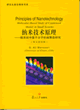
Chapter 1 — Advances in Atomic and Molecular Nanotechnology
Introduction
The Importance of Nanoscale
Atomic and Molecular Basis of Nanotechnology
Some Recent Key Inventions and Discoveries
Scanning Tunneling Microscope
Atomic Force Microscope
Diamondoids
Buckyballs
Carbon Nanotubes
Cyclodextrins, Liposome and Monoclonal Antibody
Ongoing Research and Development Activities
Future Prospects in Nanoscience and Nanotechnology
Conclusions and Discussion
Some Important Related INTERNET Sites
Bibliography
Chapter 2 — Nanosystems Intermolecular Forces and Potentials
Introduction
Covalent and Noncovalent Interactions
Interatomic and Intermolecular Potential Energies and Forces
Experimental and Theoretical Development of Interparticle Potentials
Step (1): AFM Measurement and Empirical Modeling
Step (2): Theoretical Modeling
Linearized Augmented Plane Wave (LAPW)
Full-Potential Linearized Augmented Plane Wave (FLAPW)
Step (3): Development of Nanoparticle Potentials
Phenomenological Interatomic and Intermolecular Potentials
1. Interatomic Potentials for Metallic Systems
1.1. The Many-Body Embedded-Atom Model (EAM) Potentials
1.2. The Many-Body Finnis and Sinclair (FS) Potentials
1.3. The Many-Body Sutton and Chen (SC) Long-Range Potentials
1.4. The Many-Body Murrell-Mottram (MM) Potential
1.5. The Many-Body Rafii-Tabar and Sutton (RTS) Long-Range Alloy Potentials
1.6. Angular-Dependent Potentials
2. Interatomic Potentials for Covalently-Bonding Systems
2.1. The Tersoff Many-Body C-C, S i-Si and C-Si Potentials
2.2. The Brenner-Tersoff-Type First Generation Hydrocarbon Potentials
2.3. The Brenner-Tersoff-Type Second Generation Hydrocarbon Potentials
3. Interatomic Potential for C-C Non-Covalent Systems
3.1. The Lennard-Jones and Kihara Potentials
3.2. The exp-6 Potential
3.3. The Ruoff-Hickman Potential
4. Interatomic Potential for Metal-Carbon System
5. Atomic-Site Stress Field
Conclusions and Discussion
Bibliography
Chapter 3 — Thermodynamics and Statistical Mechanics of Small Systems
Introduction
Thermodynamic Systems in Nanoscale
Energy, Heat and Work in Nanosystems
Laws of Thermodynamics
The Zeroth Law
The First Law
The Second Law
The Third Law
Statistical Mechanics of Small Systems
Thermodynamics and Statistical Mechanics of Nonextensive Systems
Euler's Theorem of Homogenous Functions
Boltzmann and Boltzmann-Gibbs Formulae of Entropy
Tsallis Formula of Entropy
Microcanonical Ensemble for Nonextensive Systems
Canonical Ensemble for Nonextensive Systems
Conclusions and Discussion
Bibliography
Chapter 4 — Monte Carlo Simulation Methods for Nanosystems
Introduction
Generating Random Numbers
Generating Uniformly Distributed Random Numbers in [0,1)
Generating Random Numbers in [a,b) According to a Given
Distribution Function P(x)
Importance Sampling
Monte Carlo Integration Method
Applications to Nanosystems Composed of a Few Particles
Equilibrium Statistical Mechanics and Monte Carlo Method
The Markov Process
Choice of the Transition Function
Example
Acceptance Ratios and Choice of the Moves
Other Tricks to Improve the Simulation Speed
Application of Monte Carlo to Nonequilibrium Problems
The Langevin Equation
Interacting Systems
Conclusions and Discussion
Bibliography
Chapter 5 — Molecular Dynamics Simulation Methods for Nanosystems
Introduction
Principles of MD Simulation of Nanosystems
Integration of Newton Equation of Motion
1. The Velet Method
2. The Leap-Frog Method
3. The Velocity-Verlet Method
4. The Gear Predictor-Corrector Method
Choice of the Time Increment At
MD Simulation of Systems in Contact with a Heat Bath: Thermostats
1. Velocity Scaling Thermostat
2. The Nose-Hoover Extended-System Thermostat
3. The Langevin Thermostat
Calculations Resulting from MD Simulations
Conclusions and Discussion
Bibliography
Chapter 6 — Computer-Based Simulations and Optimizations for Nanosystems
Introduction
A. Classification of Simulation Methods Based on Accuracy and Computational Time
Methods with the Highest Degree of Accuracy(Very CPU-Intensive)
Methods with the Second Highest Degree of Accuracy
Semi-Empirical Methods
Stochastic Methods
B. Classification of Optimizations in Molecular Simulations
Local Optimization Methods
1. Steepest Descent Method (SDM)
2. Damped Newtonian Dynamics Method
3. Conjugate Gradients Method (CGM)
4. Quasi-Newton Methods
Global Optimization Methods
1. Simulated Annealing Method
2. Genetic Algorithm
Conclusions and Discussion
Bibliography
Chapter 7 — Phase Transitions in Nanosystems
Introduction
The Gibbs Phase Rule
Phase Transitions
A Comparison of Phase Transitions Between Small and Large Systems
Fragmentation
Experimental Observations of Phase Transitions in Small Systems
1. Evaporation of Water in a Sealed Nanotube
2. Micellization and Coacervation
3. An Example of Crystallization
Conclusions and Discussion
Bibliography
Chapter 8 — Positional Assembly of Atoms and Molecules
Introduction
Positional (or Robotic) Assembly
Scanning Probe Microscopy
1. Topografiner
2. Quantum Mechanical Tunneling Effect
3. Piezoelectric Phenomena
4. Scanning Tunneling Microscope (STM)
5. Electronics Feedback Loop
6. Atomic Force Microscope (AFM)
Applications of STM for Positional Assembly of Molecules
Conclusions and Discussion
Bibliography
Chapter 9 — Molecular Self-Assembly
Introduction
The Five Factors Responsible for Self-Assembly
(1). The Role of Molecular Building Blocks (MBBs) in Self-Assembly
(2). The Role of Intermolecular Interactions in Self-Assembly
(3). Reversibility
(4). Molecular Mobility
(5). Process Medium
Some Examples of Controlled Self-Assemblies
(A). Self-Assembly Using Solid Surfaces-Immobilization
Techniques
(A-1). Affinity Coupling via Antibodies
(A-2). Affinity Coupling by Biotin-Streptavidin
(Bio-STV) System and Its Modification
(A-3). Immobilized Metal Ion Complexation (IMIC)
(A-4). Self-Assembled Monolayer (SAM)
(A-4-1). Physical Adsorption
(A-4-2). Inclusion in Polyelectrolytes or
Conducting Polymers
(A-4-3). Inclusion in SAM
(A-4-4). Non-Oriented Attachment to SAM
(A-4-5). Oriented Attachment to SAM
(A-4-6). Direct Site-Specific Attachment to Gold
(A-5). Strain Directed Self-Assembly
(A-6). DNA Directed Self-Assembly
(A-7). Self-Assembly on Silicon Surfaces
(B). Self-Assembly in Fluid Media
Conclusions and Discussion
Bibliography
Chapter 10 — Dynamic Combinatorial Chemistry
Introduction
Dynamic Combinatorial Library (DCL)
Challenges and Limitations in Designing a DCL
(i) The Nature of DCL Components and Templates
(ii) The Types of Intermolecular Interactions in DCL
(iii) Thermodynamic Conditions
(iv) Methods of a DCL Analysis
Molecular Recognition
Some Examples and Applications of DCL
Host-Guest Chemistry
Conclusions and Discussion
Bibliography
Chapter 11 — Molecular Building Blocks — Diamondoids
Introduction
Molecular Building Blocks
Diamondoids
Some Physical and Chemical Properties of Diamondoid
Molecules
Synthesis of Diamondoids
General Applications of Diamondoids
Application of Diamondoids as MBBs
Diamondoids for Drug Delivery and Drug Targeting
DNA Directed Assembly and DNA-Adamantane-Protein
Nanostructures
Diamondoids for Host-Guest Chemistry
Conclusions and Discussion
Bibliography

 中国大学出版社协会 |
首页 |
宏观指导 |
出版社天地 |
图书代办站 |
教材图书信息 |
教材图书评论 |
在线订购 |
教材征订
中国大学出版社协会 |
首页 |
宏观指导 |
出版社天地 |
图书代办站 |
教材图书信息 |
教材图书评论 |
在线订购 |
教材征订